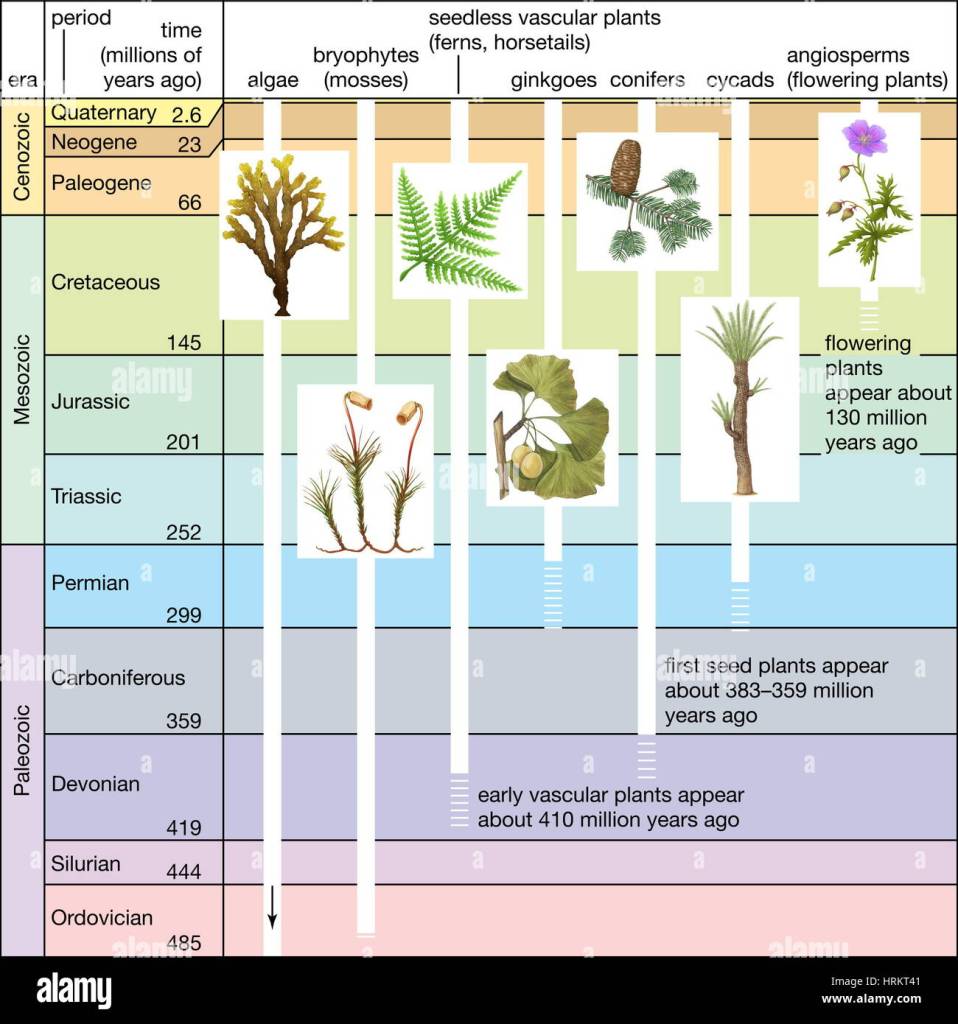
Plants have been evolving for millions of years creating a wide variety of species. About 250 million years ago at the start of the Mesozoic Era plants looked completely different from the ones today; many have evolved but others were lost to time. The Triassic, Jurassic, and Cretaceous also looked completely different from each other.
During the Triassic period when the supercontinent Pangea was the only landmass on earth, there wasn’t much diversity among plants. These plants included conifers, seed ferns, cycads and cyceoids, horsetails, ginkos, and early angiosperms. During this time period life was rebuilding from the mass extinction at the end of the Permian period. In the Triassic period, it was a mostly barren landscape with scattered greenery.
Millions of years later the world finally started to recover which sprouted the Jurassic period. Similar to the Triassic period, the Jurassic period had many non-flowering plants. Instead of shorter trees spread around, the Jurassic started to have taller conifer forests that thrived with greenery. Between the two main landmasses, Laurasia and Gondwana, the landscape was mostly dominated by conifer trees, cycads, and ferns; no longer barren compared to the Triassic.
The Cretaceous was the most developed time period. It was a beautiful, lush, and green environment. 130 million years ago, the first flowering plants appeared; magnolias. Their white color popped against the solely green landscape. About 50 million years later, grass started to appear in small meadows. Over time, many herbivores started to rely on these new grasses and flowers for food. Flowering plants needed a way to protect themselves, sprouting early versions of the thorny flowers we have today.
Plant life has succeeded and evolved in many ways to survive. From ferns to ginkgos and from cycads to conifers they have evolved in many ways to face predators. But, about 66 million years ago a tragedy struck earth wiping out nearly 75% of all species. The meteor hit off the coast of Mexico, causing a global winter that blocked out the sun for years. Photosynthesis is so crucial for plants, being without the sun for years caused a complete crash in many populations. But, plant life found sun and found a way to survive and thrive. It took millions of years for plant life to resurface but it ended up sprouting the early relatives of the beautiful, lush, greenery we see today.


Leave a Reply